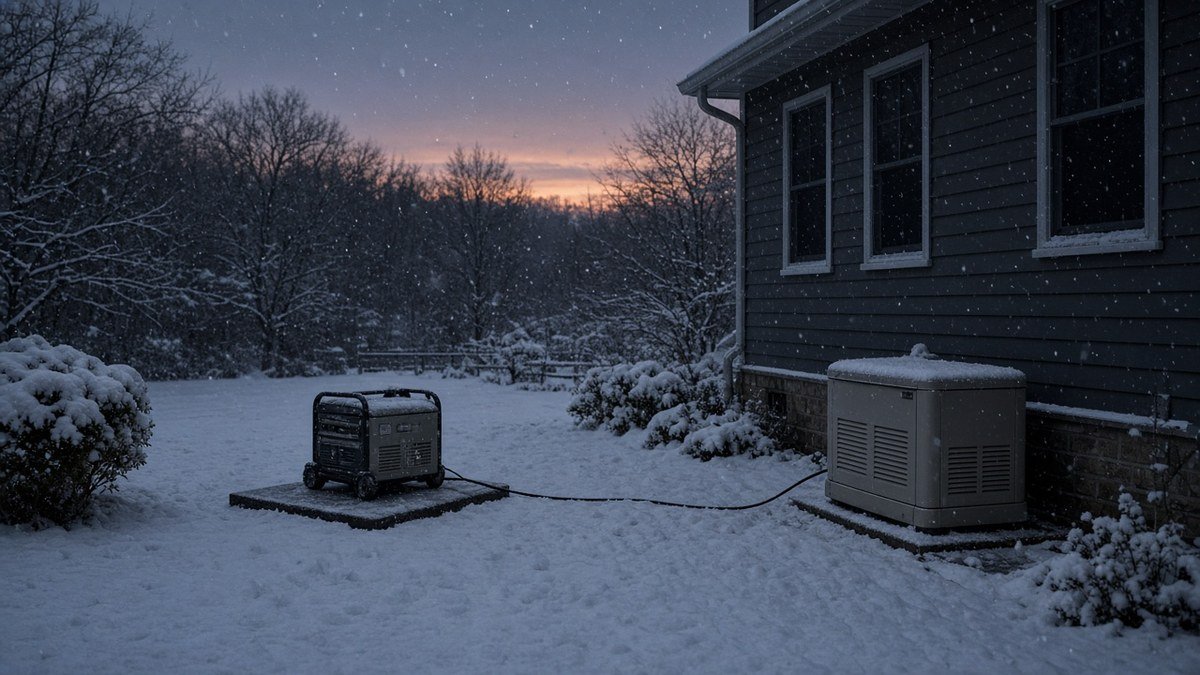
Ice on the lines, a heavy wet snow or a wind storm coming over the ridges can leave parts of Fayette and Westmoreland County without power for hours or days. In winter that is more than an inconvenience. Most furnaces need electricity to run, sump pumps stop, and a cold house puts pipes at risk.
A generator is the most common backup plan. This guide covers the two main types, how they connect to your house, the safety rules that matter most and the related electrical work you can budget for now, before the next storm.
Portable vs. standby generators
Portable generators
A portable generator is a gas-powered unit you store in a shed or garage and roll outside when the power goes out. You run extension cords to a few appliances, or connect it to selected house circuits through a transfer switch or an inlet with an interlock.
- Lower upfront cost and no permanent installation
- You have to start it, fuel it and move it outside during the storm
- Powers a limited number of circuits, so you pick what matters most
- Needs fuel on hand, and gasoline does not store well for long periods without care
Standby generators
A standby generator is permanently installed outside on a pad, usually runs on natural gas or propane, and starts on its own through an automatic transfer switch when utility power drops.
- No refueling or moving in the snow
- Can be sized for selected circuits or the whole house
- Higher cost, and it needs a gas or propane supply, a concrete or composite pad, a permit and a licensed electrician
- Needs routine maintenance like any engine
For many households in our area, the deciding question is simple: do you need the furnace, well pump and sump pump to keep running while you are away from home? If yes, a standby unit is worth pricing. If you are usually home and can manage a few key circuits, a portable unit with a proper transfer setup may be enough.
Carbon monoxide: the rule you cannot skip
Generators produce carbon monoxide, a gas you cannot see or smell. The CPSC winter safety tips are blunt about it:
- Never run a portable generator inside a home, garage, basement, crawlspace, shed or other enclosed space, even with doors or windows open
- Run it outside only, at least 20 feet from the house, and not on a porch or in a carport
- Point the exhaust away from the house and close windows and vents near it
- Install battery-operated CO alarms, or alarms with battery backup, on each level and outside sleeping areas
- Look for portable models with a CO shut-off safety feature
- Clear snow away from the outside vents for your furnace and other fuel-burning appliances
The CPSC guide to generators and carbon monoxide repeats the same message: generator exhaust can kill in minutes, so the unit belongs outside, far from windows, doors and vents.
Never backfeed through an outlet
Plugging a generator into a wall outlet with a homemade “double male” cord is dangerous. It can send power back out onto the utility lines, putting line crews at risk, and it can overload your home wiring. The safe ways to connect a generator to house circuits are a transfer switch or a generator inlet with a breaker interlock, installed by a licensed electrician with the permit your municipality requires.
Sizing and wire runs
Make a list of what you actually need during an outage: furnace blower and controls, sump pump, refrigerator, well pump if you have one, a few lights and phone chargers. The appliance labels or manuals list running watts. An electrician can turn that list into a generator size and decide which circuits go on the transfer switch.
If the generator will sit at the far side of the yard, the length of the cord or wire run matters. Our Electrical – Voltage Drop calculator estimates the percentage drop for a given load, voltage and one-way length, and suggests a minimum wire gauge to stay under a target percentage. Use it to sanity-check a cord or feeder length, then let your electrician confirm the final wire size. For a standby unit, the Concrete – Slab Volume & Bags calculator can rough out the concrete for a small pad if the manufacturer allows a poured base.
Related electrical costs (planning estimates)
Our estimator does not price generators themselves; equipment prices vary widely by size, fuel and brand, so get written quotes for the unit. It does price the electrical work that often comes with a generator project. These planning ranges come from the PA Home Repair Estimator at the Standard level with the Pittsburgh / Western PA region setting. They are not quotes.
- Small electrical repair or addition (a single circuit or device): about $160 to $540, typical around $350
- Partial wiring work: about $1,000 to $5,000, typical around $2,500
- Electrical panel upgrade: about $1,150 to $4,250, typical around $2,300
Older homes sometimes need a panel upgrade before a transfer switch can be added cleanly. If your panel is crowded, has fuses or has had problems, ask the electrician about it while they are already there.
Before the next storm
- Test-run a portable generator outside and confirm it starts
- Store fuel safely and follow the manufacturer’s storage guidance
- Test CO and smoke alarms and replace batteries if needed
- Know where your main breaker and water shutoff are
- Read our guide to preventing frozen pipes in Pennsylvania in case the heat is off for a while
- Keep the furnace serviced; our post on furnace repair or replacement covers what to watch for
- Work through our Western PA winter maintenance checklist
Questions to ask an electrician
- Which circuits should go on the transfer switch for my needs?
- Is my current panel suitable, or does it need work first?
- Is the permit included in the price?
- Where will the inlet or transfer switch be located, and how far is the run?
- For standby units, who handles the gas or propane connection?
Our Before You Hire checklist covers licensing, insurance and written contracts for any contractor.
Next step: price the electrical side of your backup power plan
Open the free PA Home Repair Estimator and run the jobs that match your situation so you have a planning range before you call anyone. If you want something on paper, you can add the $7 Project Planning Guide (a printable estimate with itemized lines, questions for contractors and PA contract basics), the $12 Job Kit (a scope checklist and a worksheet to compare up to three bids), or the $25 Project Pack, which includes both plus a Bid Check worksheet to compare each bid with your estimate range.
Cost figures are estimates for planning only, not quotes. Actual prices depend on your home, your contractor and current material costs.