General information, not professional advice. Pahome Repair Estimator is a free estimate tool, not a contractor, and we do not sell radon test kits or install radon systems. The facts below come from the Pennsylvania Department of Environmental Protection (DEP) and the U.S. Environmental Protection Agency (EPA), linked in the Sources list. For your home, follow DEP’s guidance and talk with a DEP-certified radon professional.
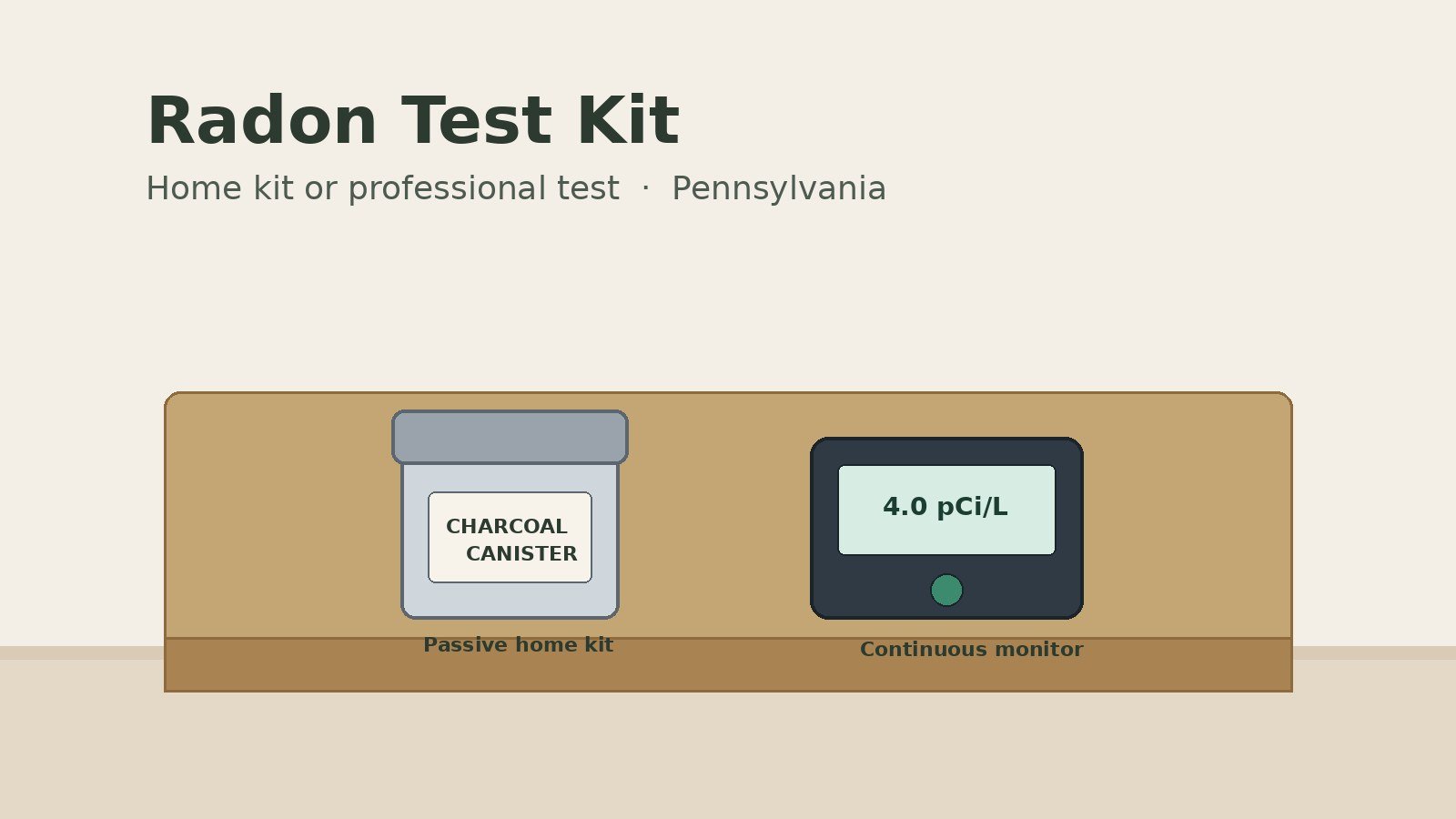
If you need a radon test kit for a Western Pennsylvania home, you can place a do-it-yourself kit and mail it to a certified lab, or hire a DEP-certified tester. This post covers how those options differ, how to read a result against the 4 pCi/L action level, and what DEP says to do next. For mitigation, home sales, and DEP’s county directories, see our full guide, Radon Testing and Mitigation in Western PA.
Home radon test kits vs. a professional test
On its Radon in the Home page, DEP says an easy-to-use home test kit can be purchased at hardware or home improvement stores for about $20 to $30. Kits are also sold by Pennsylvania-certified radon laboratories. You place the kit for the time on the package, mail it to the lab listed on it, and the lab sends you the result.
DEP’s Radon and Testing fact sheet adds two buying details. Most laboratories include the device and the analysis in one price, but some kits are sold cheaper with an analysis fee due later, so read the package. And any store or website may sell a kit—the laboratory that analyzes it must be certified by DEP. Check the package, or confirm the lab on DEP’s Radon Services Directory. DEP also says kits from certified labs are held to the same quality standards as the devices certified testers use, and DEP runs performance evaluations on them. Follow the directions carefully, including before you unseal the kit.
Pennsylvania law requires anyone who tests, mitigates, or analyzes radon for others to be DEP-certified. Homeowners may test their own homes. DEP suggests hiring a certified tester when you are buying or selling a home, or if you would rather not place and retrieve the device yourself. Ask to see the tester’s DEP certification ID, or look the person or firm up in the Radon Services Directory.
Short-term vs. long-term tests
DEP recommends that homeowners start with a short-term test. The fact sheet says those devices usually take two to four days. DEP’s Pennsylvania Citizen’s Guide to Radon, and EPA’s Home Buyer’s and Seller’s Guide to Radon (EPA 402/K-24/001, March 2024, revised), both describe short-term tests as lasting two days to 90 days, depending on the device. EPA also says every radon test should run at least 48 hours, and that some devices need a longer minimum, such as a 7-day charcoal canister.
A long-term test stays in the home more than 90 days. DEP’s fact sheet says at least 91 days, and preferably one year. Because radon levels change from day to day and season to season, a long-term test is more likely to reflect your year-round average. A short-term test is accurate for the days it was in place, and it is the faster way to get a first reading.
Charcoal kits, other passive devices, and continuous monitors
DEP’s Citizen’s Guide lists the devices most often used for short-term testing: charcoal canisters, alpha-track detectors, electret ion chambers, continuous monitors, and charcoal liquid scintillation detectors. For long-term testing, alpha-track and electret detectors are the ones commonly used. EPA’s 2024 buyer’s guide groups those devices this way:
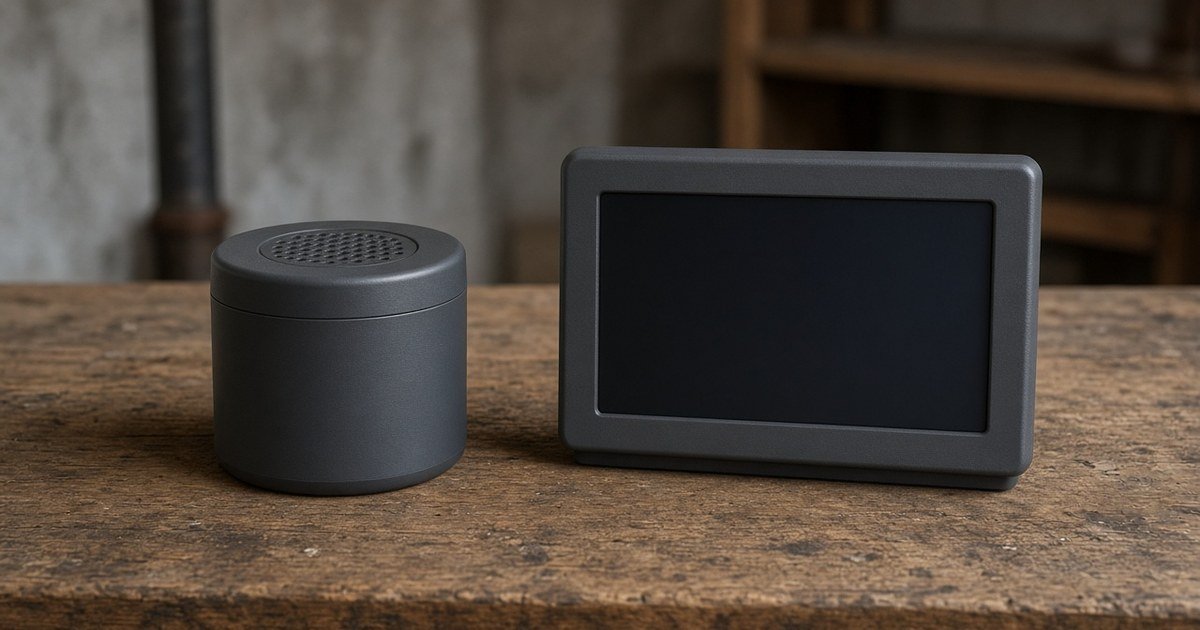
- Passive devices do not need power. This group includes charcoal canisters, alpha-track detectors, charcoal liquid scintillation devices, and electret ion chamber detectors. EPA says they are sold in hardware, drug, and other stores, or can be ordered by mail. You expose the device to the air in the home for the time specified, then send it to a laboratory for analysis. EPA describes both short-term and long-term passive devices as generally inexpensive.
- Active devices need power. This group includes continuous radon monitors and continuous working level monitors. They measure and record radon, or its decay products, throughout the test. EPA notes that many of these devices produce a report that can show unusual swings during the test period, and that a qualified tester can explain that report. These tests may cost more, and EPA says they may provide a more reliable result.
A home radon test kit from a hardware store is typically a passive short-term device, most often a charcoal canister or a similar charcoal liquid scintillation kit. A professional test may use the same kind of passive device, or a continuous monitor. Either way, in Pennsylvania the lab or the tester must be DEP-certified when the work is done for someone else.
How to place a kit so the result is usable
Follow the instructions that come with your kit. DEP’s Citizen’s Guide says to test the lowest lived-in level of the home (the basement if it is used often, otherwise the first floor) in a regularly used room such as a living room, playroom, den, or bedroom—not a kitchen or bathroom. Place the kit at least 20 inches above the floor, away from drafts, high heat, high humidity, and exterior walls, where it will not be disturbed. DEP notes that radon is often highest in the basement, but it can also be high above ground, even in homes without basements.
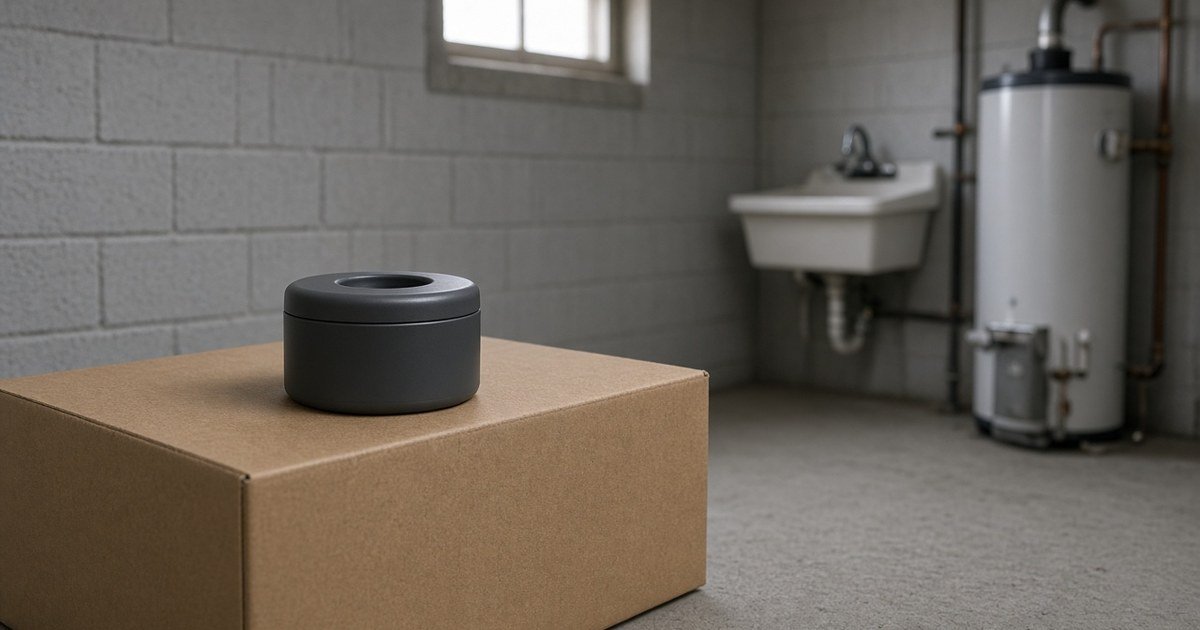
For a short-term test, keep windows and outside doors closed as much as possible. Heating and air-conditioning fans that recirculate indoor air may run; do not run fans that bring in outdoor air. For a two- or three-day test, close windows and outside doors at least 12 hours before you start, and do not test during unusually severe storms or high winds. DEP says the best time to test is during the colder months, when homes are closed up and radon is most likely to build up. When the test is done, reseal the package and send it to the Pennsylvania-certified lab right away. DEP says you should receive results within a few weeks.
How to read a result, and the 4 pCi/L action level
Radon in air is reported in picocuries per liter (pCi/L). DEP uses EPA’s action guideline of 4 pCi/L. DEP and EPA both say that even levels below 4 pCi/L still pose some risk, and that most homes can be reduced to 2 pCi/L or below. About 40% of homes tested in Pennsylvania have been above 4 pCi/L, according to DEP, and the only way to know your home’s level is to test.
EPA and DEP’s Citizen’s Guide lay out three steps. Start with a short-term test; if the result is 4 pCi/L or higher, take a follow-up test. Follow up with a long-term test if you want a better year-round average, or a second short-term test if you need results quickly. If your first short-term result is more than twice the 4 pCi/L action level, take a second short-term test right away. If the long-term follow-up is 4 pCi/L or more, or the average of two short-term tests is 4 pCi/L or higher, both guides say to fix the home.
When a short-term result is close to the action level, it is harder to tell whether the year-round average is above or below 4 pCi/L. DEP’s fact sheet says a long-term test (at least 91 days, preferably a year) can be appropriate when the short-term result is between 4 and 10 pCi/L. On its Radon in the Home page, DEP says that if a result falls between 4 and 8 pCi/L, you can run a long-term test or another short-term test, and that if a confirming result is still 4 pCi/L or higher, you should take corrective action. EPA’s example of the uncertainty close to the line: if the average of two short-term tests is 4.1 pCi/L, there is about a 50 percent chance the year-round average is somewhat below 4 pCi/L. For help reading a result, call DEP’s Radon Division at 717-783-3594 or the Radon Hotline at 800-237-2366.
What to do next
If follow-up testing confirms a level at or above 4 pCi/L, DEP says to reduce radon in the home. Anyone you hire must be a DEP-certified radon mitigator. Use the county-sorted list in the Radon Services Directory, ask for a current DEP ID, and get estimates before you decide. In its January 12, 2026, Radon Action Month release, DEP says permanent radon mitigation systems typically cost between $800 and $1,200 and need minimal maintenance. Costs vary by house, so treat that as DEP’s published range, not a bid for your home.
Our Western PA radon testing and mitigation guide walks through how those systems work, when DEP says to retest, and how testing fits a home sale. Pahome’s free home repair estimator has no radon category, so it cannot quote a radon test or a mitigation job. It can still give a planning range for related basement work, such as waterproofing. Those figures are planning ranges, not contractor quotes.
Sources
- DEP: Radon in the Home
- DEP fact sheet: Radon and Testing (PDF)
- DEP: Pennsylvania Citizen’s Guide to Radon (PDF)
- DEP Radon Services Directory
- DEP news release, January 12, 2026: Radon Action Month
- EPA: Home Buyer’s and Seller’s Guide to Radon, EPA 402/K-24/001 (March 2024, revised) (PDF)
- EPA: A Citizen’s Guide to Radon (2016) (PDF)
General information, not professional advice. Radon guidance and certification lists change, so check the DEP and EPA pages above for current details and talk with a DEP-certified professional about your home. Sources checked November 17, 2026.
— Mike